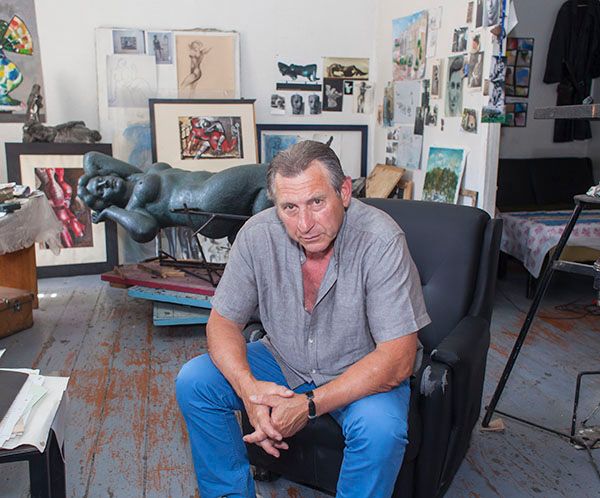
About Gennady (Gena) Lakoba
My name is Gennady Lakoba. I was born on August 11, 1948, in Sukhum, Abkhazia.
In 1962, I enrolled at the Sukhum Art School, where I had the privilege of interacting with prominent figures who significantly influenced my artistic growth, such as the renowned Russian artist Varvara Bubnova (who spent 40 years living in Japan), art critic Pyotr Kulchitsky (a close associate of Pavel Filonov), artist Sandro Razmadze, sculptor Merab Tsintsabadze, and artist Tatiana Shalamberidze.
I studied sculpture at the Tbilisi Academy of Arts from 1969 to 1975. My drawing instructor was Vasili Shukhaev, an accomplished artist who collaborated with Sergei Diaghilev in Paris during the 1920s. At the Academy, I also studied sculpture under the guidance of Shota Mikatadze, Nicholas Kandelaki, Gogi Ochiauri, and Merab Tsintsabadze.
In 1976, I joined the Union of Artists of the USSR. In 1978, I continued my studies in Leningrad (now Saint Petersburg).
I am a member of the International Association of Art (UNESCO), the Moscow Union of Artists, the Belarusian Union of Artists and the Artists’ Union of Abkhazia, and an Honorary Member of the Russian Academy of Arts.
Since 1992, I have lived and worked in Belarus (Grodno), Russia (Moscow), and Spain (Marbella). I now live and work in Spain, where I work on a series of sculptures in bronze and marble and also create tapestries.
My sculpture Luda is in the collection of the State Russian Museum in Saint Petersburg.
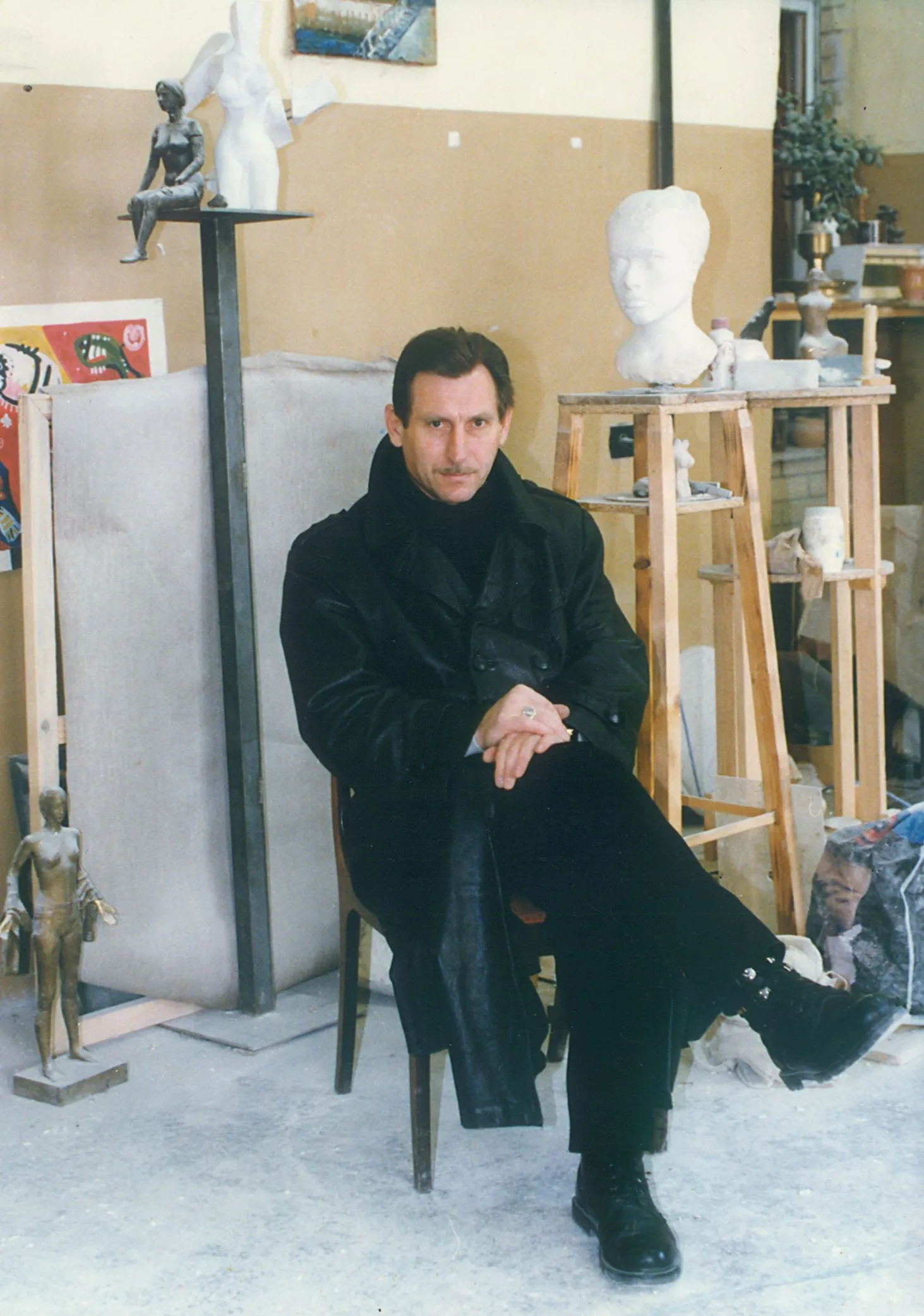
What I do
Shape analysis, which I use in my work, allows me to read not only the human figure but any object. The approach to form that Paul Cézanne pointed out is used and developed by painters and sculptors working in this direction. It is not a dogmatic scheme. As experience accumulates, the form grows richer: a play of details is created, and then the details are combined into a single whole. But the foundation — the trunk, the culture — remains unchanged.
I am a formalist. I start from form, not from a literary idea that I then follow. I work with form: heavy and light, bright and muted. The way these forms are distributed gives a work its character — sometimes dramatic, sometimes romantic. External features, such as loose hair or the way a woman looks, are not what matters.
Amazing shapes in the form of large and small volumes, convexities and concavities resembling the raging sea and the mountains, which are so similar to a female figure, are essential to my work.
My work originates in the most ancient art of mankind. I am inspired by the Venuses of the Neolithic period, the most ancient cave paintings and the great works of unknown ancient masters. My worldview was formed under the influence of the magnificent sculpture of Egypt, India and Greece, and finally of European sculpture of the late 19th and 20th centuries. I cannot fail to mention the great architect Frank Owen Gehry, who turned architecture into plastic objects of sculpture without diminishing the importance of architecture itself. Deep immersion in the study of art in museums around the world allows me to analyze cultural events in contemporary art. At first glance, it is impossible to compare the various stages in the development of human culture, but this is not so. I am sure that these stages are encoded and present in every person, and if this person is also an artist, he perceives today’s world more sharply, improvises and creates unexpected works. The knowledge I have acquired allows me to travel in the endless space of art in the hope of finding something new that may belong to culture and whose value will be beyond time and space.
The accumulated knowledge makes me strive, irresistibly and passionately, for the sculptures I have not yet created.
Sculpture loves silence. There is no need to talk a lot about it. It is silent and self-sufficient, like a sphinx.
Sculpture does not like abrupt movements or revolutions. Real sculpture is a great culture that is always modern, regardless of time.
Critics on Gena Lakoba
I haven’t seen any other artist talented to such an extent and so obviously predestined for the decoration of big public buildings, majestic walls and structures — and moreover in the most original and impressive artistic images. Unfortunately, fortune hasn’t yet turned to him with this side. But I still hope and believe that there will appear the people and the countries for which Gennady Lakoba will be able to create his images of heroic courage, the spirit of power and beauty.
— Anatoli Kantor, President of the Art Critics’ Academy of Russia, Merited Art Worker of Russia
Gennady Lakoba is the name in modern art which I hope will represent our time to following generations with dignity. He is a serious artist creating not “goods” but “works”. Possessing a powerful innate gift, Gennady Lakoba also uses in his creative work the golden reserve of cultural and artistic erudition, which enables him to seek himself in various creative directions and to create his own unique style while learning from the masters of the past.
— Larisa Skobkina, art critic, Department Head of the Central Exhibition Hall “Manege”, Saint Petersburg
Gennady Lakoba gives the impression of a contemporary artist of the European type, based on traditional modernism, capable of a wider contextual assessment of works of art and other phenomena of the realities of life. Since 1992 he has lived in Belarus, travelling around the world and showing his works in museums and galleries — in Germany, France, Croatia, Spain and America, and of course in Minsk, Grodno, Moscow and Saint Petersburg. He does not forget Abkhazia, where his works are well known.
— Lyudmila Pavlova, Head of the Exhibition Department of the Sochi Art Museum